
Project FeederWatch 2025 - 2026
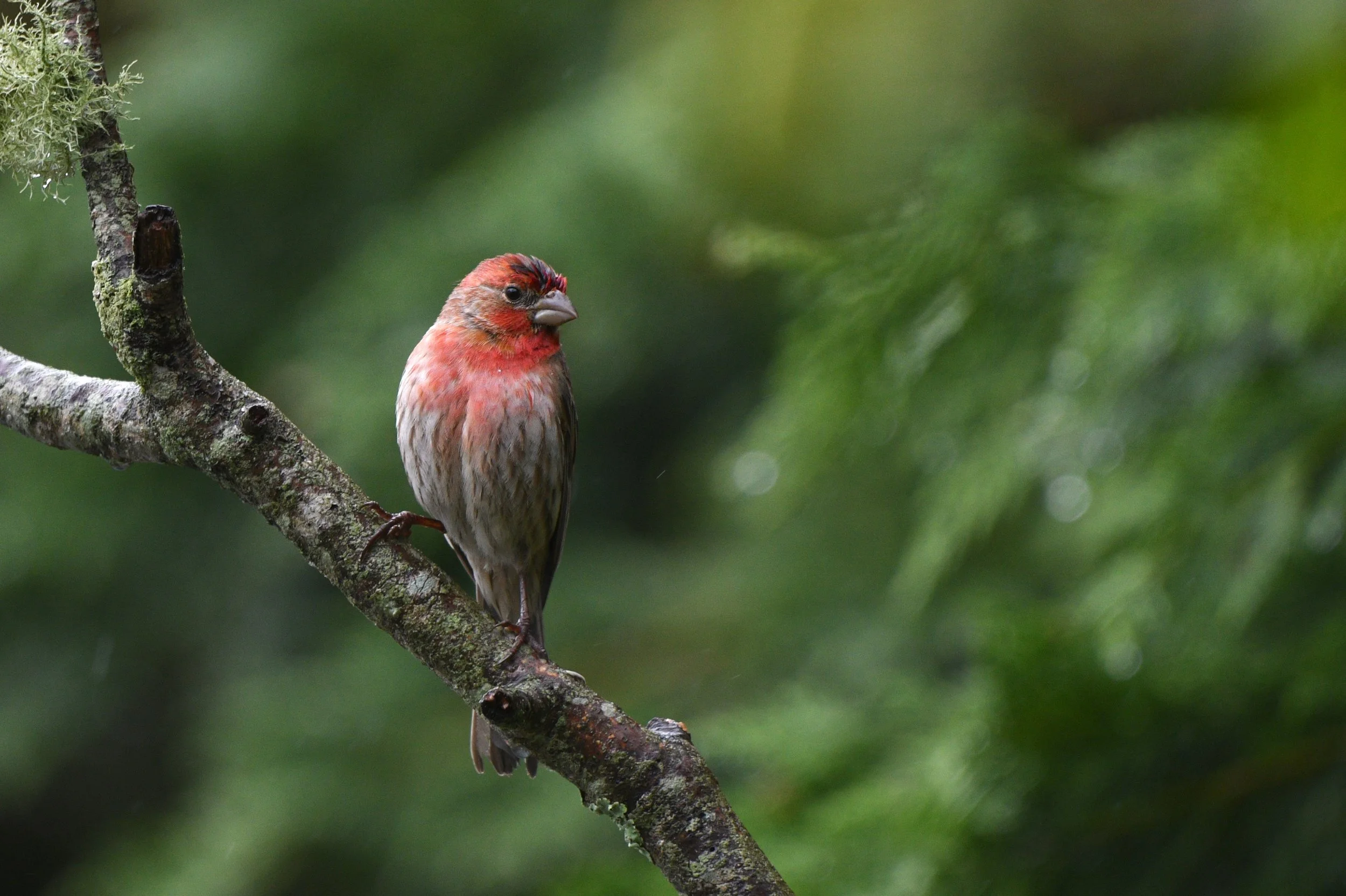
Photo: house finch by Jay Rand
This April marked the eighth season of Group for the East End’s participation in Project FeederWatch, a Cornell Lab of Ornithology community science program.
The Group’s participation in this program contributes important data on our local bird populations. Twice weekly, from November to April, novices and experts alike collect data to help provide an outline of bird populations across the U.S. and Canada.
From the survey site at Downs Farm Preserve in Cutchogue, I can observe a cross-section of the bird community in this coastal oak-hickory woodland habitat. For two hours a week, I lent my full attention to the sights and sounds of mourning doves, black-capped chickadees, and Carolina wrens, to name a few. I observed firsthand the shift in bird populations, from your common “backyard birds” to migratory species just stopping by.
Week by week, my familiarity with the calls and behaviors of varying bird species grew. With my spotting scope in one hand and a pen in the other, the data collected each week came together to paint a picture of the bird population at my observation site.
The graphs below, a feature of the Project FeederWatch website, visually display the data collected during FeederWatch seasons since 2018. These graphs help us understand the population specific to our site over several years, exemplifying the importance of community science in the field of ornithology. This visual data also helps strengthen participants’ knowledge of local ecosystems.
Take a look at past and present data sets…
Fox Sparrow, Passerella iliaca
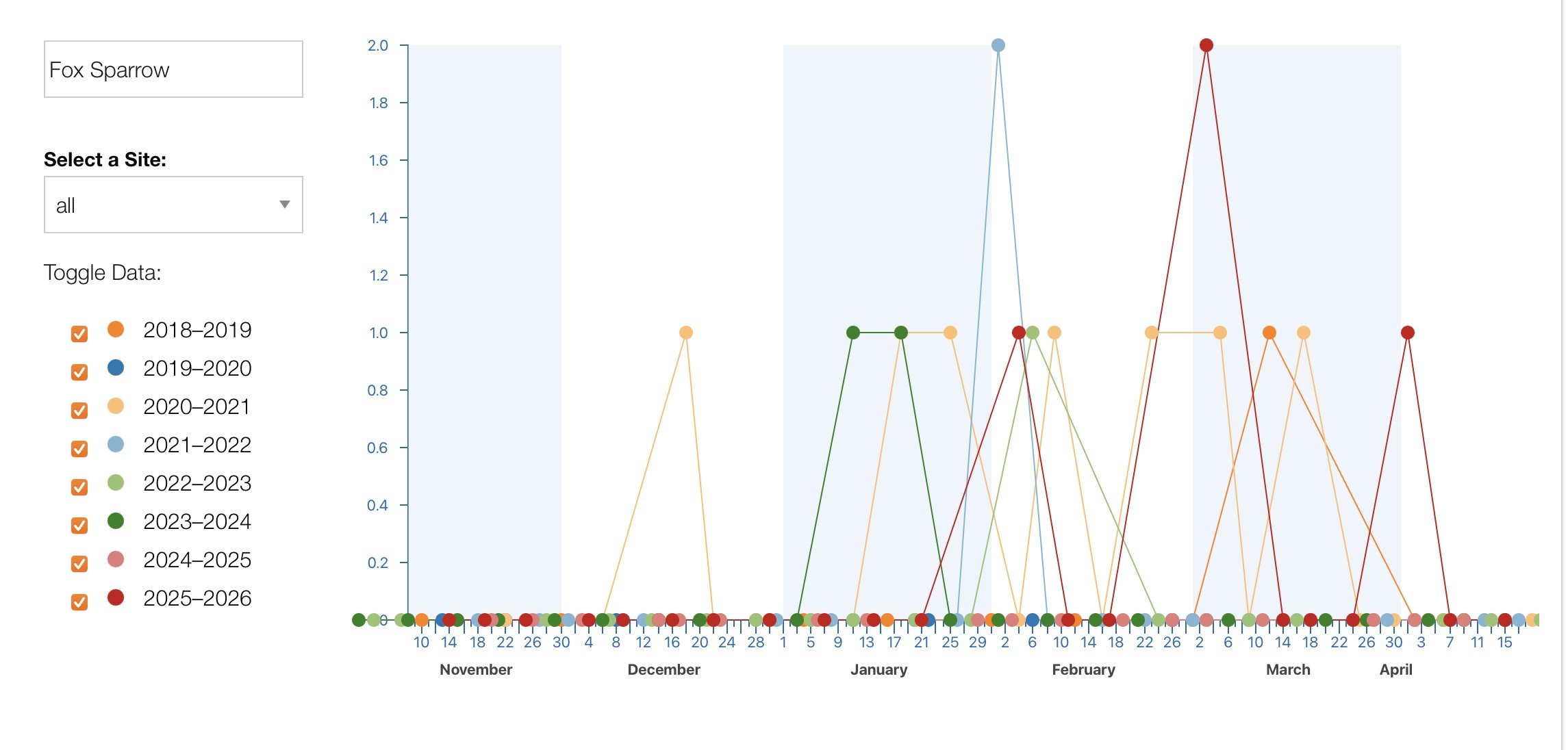
The small fox sparrow remained elusive this season. On many count days, I thought I saw its red-spotted plumage tucked within a pile of brush surrounding the feeder, but the day it finally arrived, there was no mistaking it. From 2020-2023, the data showed that the species was spotted in greater numbers, up to 14 on a single count day. This season, I mostly spotted fox sparrows individually, and only once in a pair.
While the species’ conservation status is of low concern, the drop in survey data from 2020 to now made me pause and wonder why. Fox sparrows are ground feeders that inhabit dense vegetation. It’s likely we missed some sparrows that might have been nestled in thick stands of brush, but based on the data we collected, the fox sparrow population at our survey site has been steadily declining over the last three years. They are not visiting our feeders as frequently, or in numbers as high as they used to. This could be caused by warmer winter temperatures compared to past winters, or an increase in sources of natural food in surrounding areas.
White-breasted Nuthatch, Sitta carolinensis
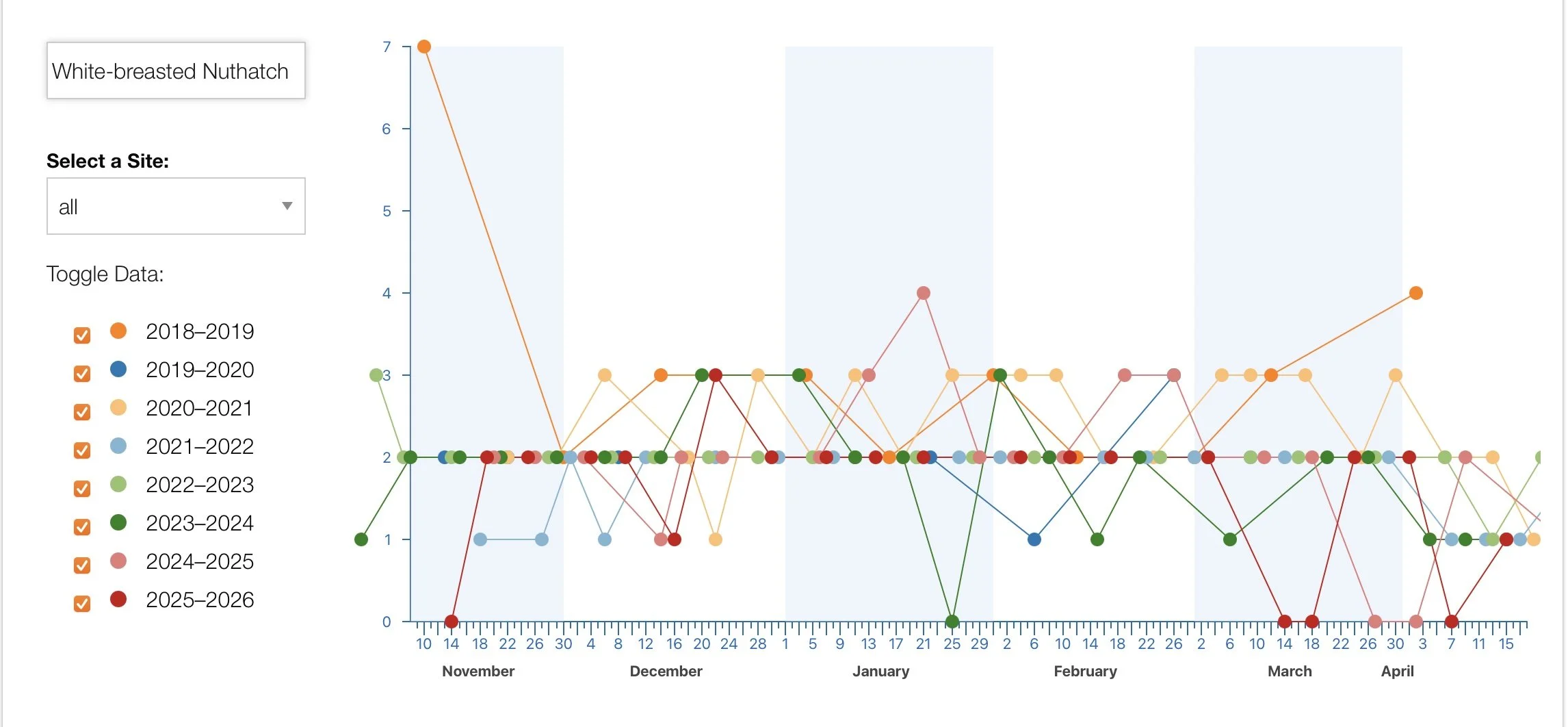
This season, the data collected on the white-breasted nuthatch provides us with a very uniform-shaped graph. In the last six months, we never encountered more than three nuthatches at a time, and the third only appeared once. On most count days, we spotted two of these birds, and data from past seasons reaffirms my theory of a mated pair with a strong hold on their territory.
White-breasted nuthatches are territorial birds, known to keep the same mate for many seasons. It was easy to watch the pair and observe their behavior, as they often spent their time together and on the same tree each week. While vertically perched on the trunk of a maple tree, the nuthatches would make frequent trips to and from the feeder, grabbing seeds and storing them in the ridges of their preferred tree.
On many occasions, we heard and watched them earn their name, smashing a nut against a tree to “hatch” the seed within. Also a species of low conservation concern, the white-breasted nuthatch is common and widespread, and likely to be spotted scaling the side of a tree in your own yard.
House Finch, Haemorhous mexicanus
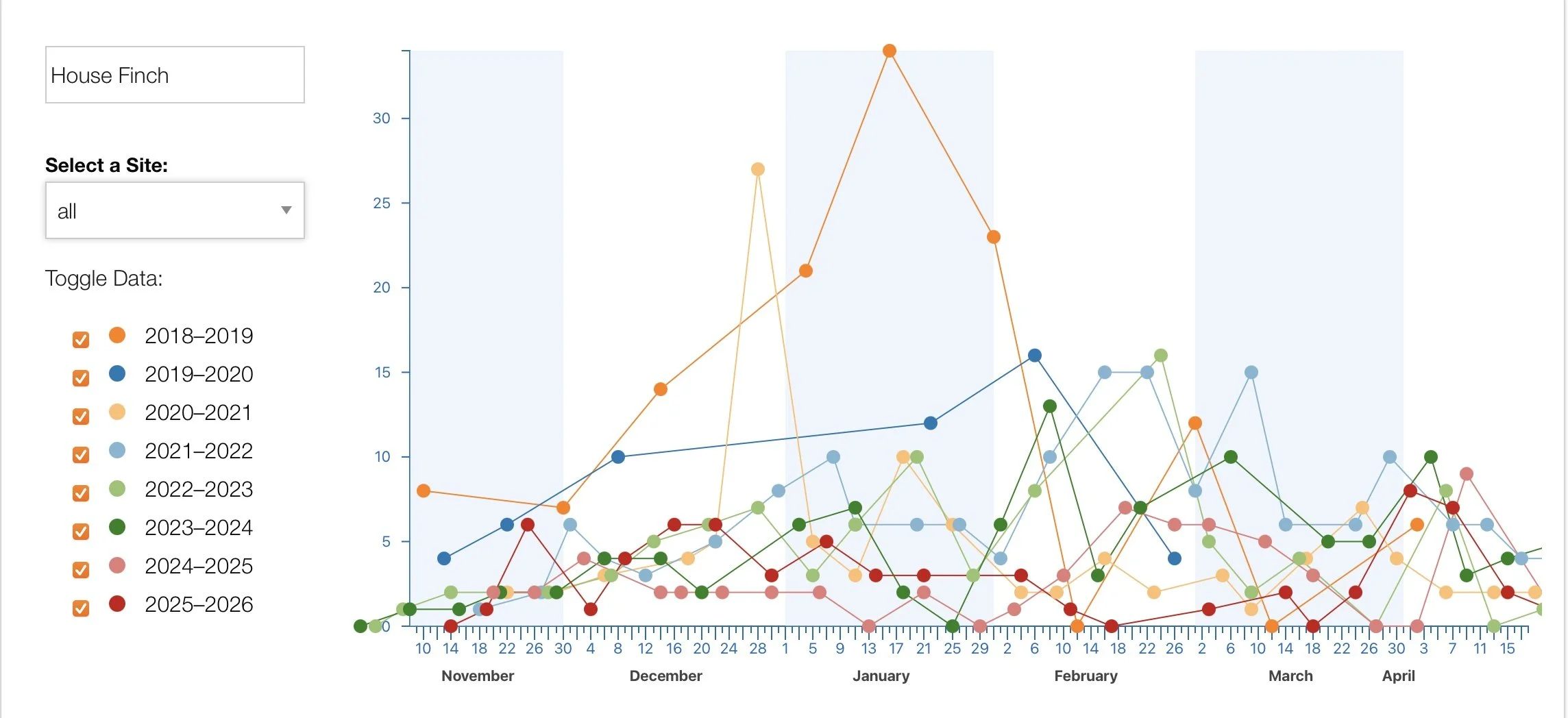
A sight of red to brown ombre, house finches are small in size but mighty in numbers. While males have a striking red head and breast in breeding plumage, the females are brown. Both sport a distinctive stout beak used for eating seeds. House finches were seen regularly at the feeder this season, and according to past data, they’ve been spotted in groups of more than 30 individuals in years prior.
The house finch is now a common sight in backyards, residential areas, and more developed habitats. Native to the Southwest, the house finch is a recent regular in the Northeast. Illegally released house finches were introduced to Long Island in the 1940s; since then, the species has spread and settled in the region.
They are a species of low conservation concern, but local populations are susceptible to conjunctivitis, a bacterial infection that causes swelling of their eyes. This ailment causes difficulty in feeding. When house finches visited the feeder, we did our best to get a glimpse of their eyes in order to check for signs of disease. Sightings of conjunctivitis are requested by Cornell Lab as part of collected FeederWatch data. At the Downs Farm Preserve survey site, most house finches could be found in the same vine-covered tree, taking turns making trips to the feeder.
House Sparrow, Passer domesticus
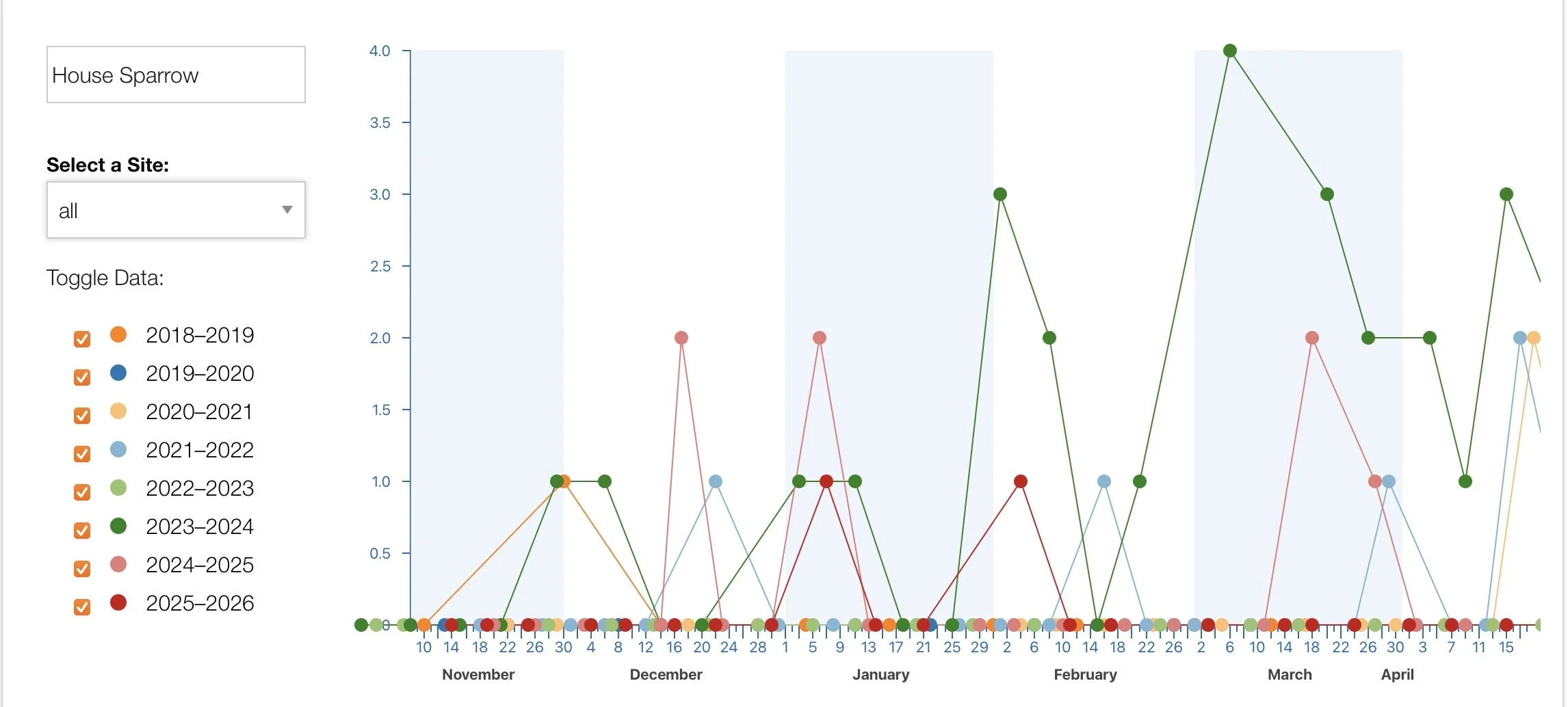
House sparrows, a ubiquitous invasive species, were not spotted at our survey site this season, and data from past years show their historically low attendance at the feeders. While they are plentiful in developed areas such as parking lots and residential neighborhoods— including my own backyard—they are scarce at Downs Farm Preserve. A fellow FeederWatcher’s blog provided potential insight into the lack of house sparrow activity at our feeders. They point out that this species does not prefer preformed, cylindrical shaped seeds. While our seed is not preformed, I do wonder if the narrow, cylindrical shape of our feeders is a discouraging quality for house sparrows.
House sparrows are an invasive species.Introduced from Eurasia and northern Africa, their populations spread quickly as they have become an established and common species across the United States. First introduced in Brooklyn in the 1800s, you can now find them congregating or nesting in manmade structures like awnings and streetlights across Long Island. They are of low conservation concern, but have been noted to pose threats to other native songbirds, outcompeting them for nesting cavities and nest boxes.
Participating in data collection for Project FeederWatch has made me keenly aware of the bird species that share our world. Every new park I visit is an opportunity for bird sightings. Birding has created a new branch in my connection to nature, and I strongly encourage everyone to explore the world of birding and nature observation. There is endless knowledge to be gained from simply paying attention to the sights and sounds around you, no feeder necessary.
Get outside and be curious!